Summary
Changes to nutrient cycles can be both a cause and effect of novel ecosystems. When nutrientcycles are altered due to biotic novelty, undeniably negative consequences can arise. However,in some cases, novel ecosystems could maintain or even enhance beneficial nutrient cycling.
Novelty and nutrient cycling
Humans care about nutrient cycling, in part because excess nutrients are a concern inlakes, on land, and in the atmosphere (Vitousek et al. 1997, Galloway et al. 2008). Thus, nutrientcycling, and particularly the storage or retention of nutrients is considered an importantecosystem service that may be affected in novel ecosystems. Proponents of both newconservation and the novel ecosystems concept are quick to point out the importance ofmanaging ecosystems for the services they provide, including the cycling and storage ofnutrients. Nutrient cycling holds an interesting place in the novelty debate, because changes tonutrient cycles are both a cause, and an effect of novelty. On the one hand, global increases innitrogen and phosphorus availability are a primary driver of abiotic novelty. Abiotic novelty inthe form of nutrient enrichment can help promote novel species assemblages as species adaptedto low nutrient soils are outcompeted by fast-growing species (of either local, or exotic origin).On the other hand, the cycles of these essential nutrients (as well as carbon) can undergoprofound change as a result of biotic novelty, which is my focus here. Although there have been relatively few papers on nutrient cycling that have specificallyidentified their study systems as novel, there has been substantial research into the effects of non-native or invasive species on ecosystem functions. While not all of these systems meet all thecriteria of some definitions of a novel ecosystem (e.g., it is hard to know how reversible eachsystem may be), they certainly represent a form of novelty.The literature on invasive species abounds with examples in which introduced specieshave had dramatic effects on nutrient cycles. For example, introduced predators on islands maydecimate ground-nesting seabird populations, and substantially reduce the flow of nutrients fromthe ocean to land (Croll et al. 2005, Fukami et al. 2006, Wardle et al. 2012). These novelnutrient regimes then may cascade down to the composition and productivity of plants that growon the islands (Fukami et al. 2006). Small islands may be particularly sensitive to this type oflocal novelty, as species may have evolved in isolation from predators.Another classic example of biotic novelty influencing nutrient cycling occurs in lakesinvaded by zebra mussels. Zebra mussels filter feed on particulates in the water column,removing nutrients from the water and depositing them in the sediments. Because zebra musselscan occur in very high abundances, these alterations to nutrient cycling can have an importantinfluence on lake food web dynamics and productivity (Covich et al. 2007, Strayer 2014). However, examples of dramatic changes in nutrient cycling following biotic novelty canbe juxtaposed against situations where biotic novelty may maintain important nutrient cycles.For example, Mascaro and others (2012) show that novel Hawaiian forests maintain nutrientcycling at or above the levels found in native Hawaiian forests. In these novel forests,introduced species increase local and regional species richness, and in particular functionaldiversity. For example, non-native nitrogen-fixing species are an important component of plantcommunities on relatively young, nitrogen-poor soils. The presence of these nitrogen-fixersincreases plant biomass and productivity, belowground carbon storage, and plant available nitrogen and phosphorus. These forests provide many of the same functions, and from certainperspectives, the novel forests greater ecosystem services than the native forests, similar to whathas been found for Puerto Rican forests (Lugo and Helmer 2004). In the end, much of the debate over the value of novel ecosystems seems to come downto conservation priorities, and system specific dynamics. In some of the systems mentionedabove, changes in nutrient cycling due to biotic novelty had obvious negative effects on certainspecies, as well as diminished ecosystem services for humans. However, in many cases, changesto nutrient cycling in novel ecosystems may provide beneficial ecosystem services. Because odifferences in system responses and conservation priorities, there is unlikely to be a ‘one-size fitsall’ approach to understanding and managing novel ecosystems for nutrient cycling.
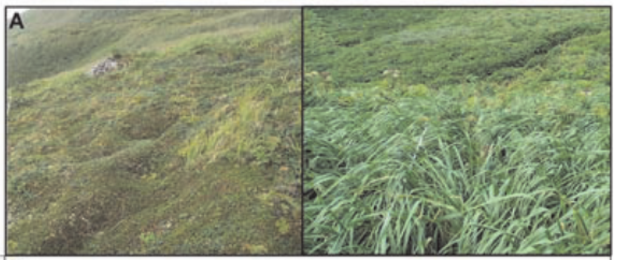
Figure from Croll et al. 2005. Foxes present on left, absent on right. The foxes limit seabird populations and thus inputs of sea nutrients to land. Overall productivity decreases as a result, as grasslands are converted to tundra.
~by Elliot Vaughn~
References
Covich, A. P., M. A. Palmer, and T. A. Crowl. 2007. The role of benthic invertebrate species in freshwater ecosystems: zoobenthic species influence energy flows and nutrient cycling. BioScience 49:119–127.
Croll, D. A., J. L. Maron, J. A. Estes, E. M. Danner, and G. V Byrd. 2005. Introduced predators transform subarctic islands from grassland to tundra. Science 307:1959–1961.
Fukami, T., D. A. Wardle, P. J. Bellingham, C. P. H. Mulder, D. R. Towns, G. W. Yeates, K. I. Bonner, M. S. Durrett, M. N. Grant-Hoffman, and W. M. Williamson. 2006. Above- and below-ground impacts of introduced predators in seabird-dominated island ecosystems. Ecology Letters 9:1299–1307.
Galloway, J. N., A. R. Townsend, J. W. Erisman, M. Bekunda, Z. Cai, J. R. Freney, L. a Martinelli, S. P. Seitzinger, and M. a Sutton. 2008. Transformation of the Nitrogen Cycle: Recent Trends, Questions, and Potential Solutions. Science 320:889–892.
Lugo, A. E., and E. Helmer. 2004. Emerging forests on abandoned land: Puerto Rico’s new forests. Forest Ecology and Management 190:145–161.
Mascaro, J., R. F. Hughes, and S. A. Schnitzer. 2012. Novel forests maintain ecosystem processes after the decline of native tree species. Ecological Monographs 82:221–228.
Strayer, D. L. 2014. Understanding how nutrient cycles and freshwater mussels (Unionoida) affect one another. Hydrobiologia 735:277–292.
Vitousek, P. M., J. D. Aber, R. W. Howarth, G. E. Likens, P. A. Matson, D. W. Schindler, W. H. Schlesinger, and D. G. Tilman. 1997. Human alteration of the global nitrogen cycle: Sources and consequences. Ecological Applications 7:737–750.
Wardle, D. a., P. J. Bellingham, T. Fukami, and K. I. Bonner. 2012. Soil-mediated indirect impacts of an invasive predator on plant growth. Biology Letters 8:574–577